.png)
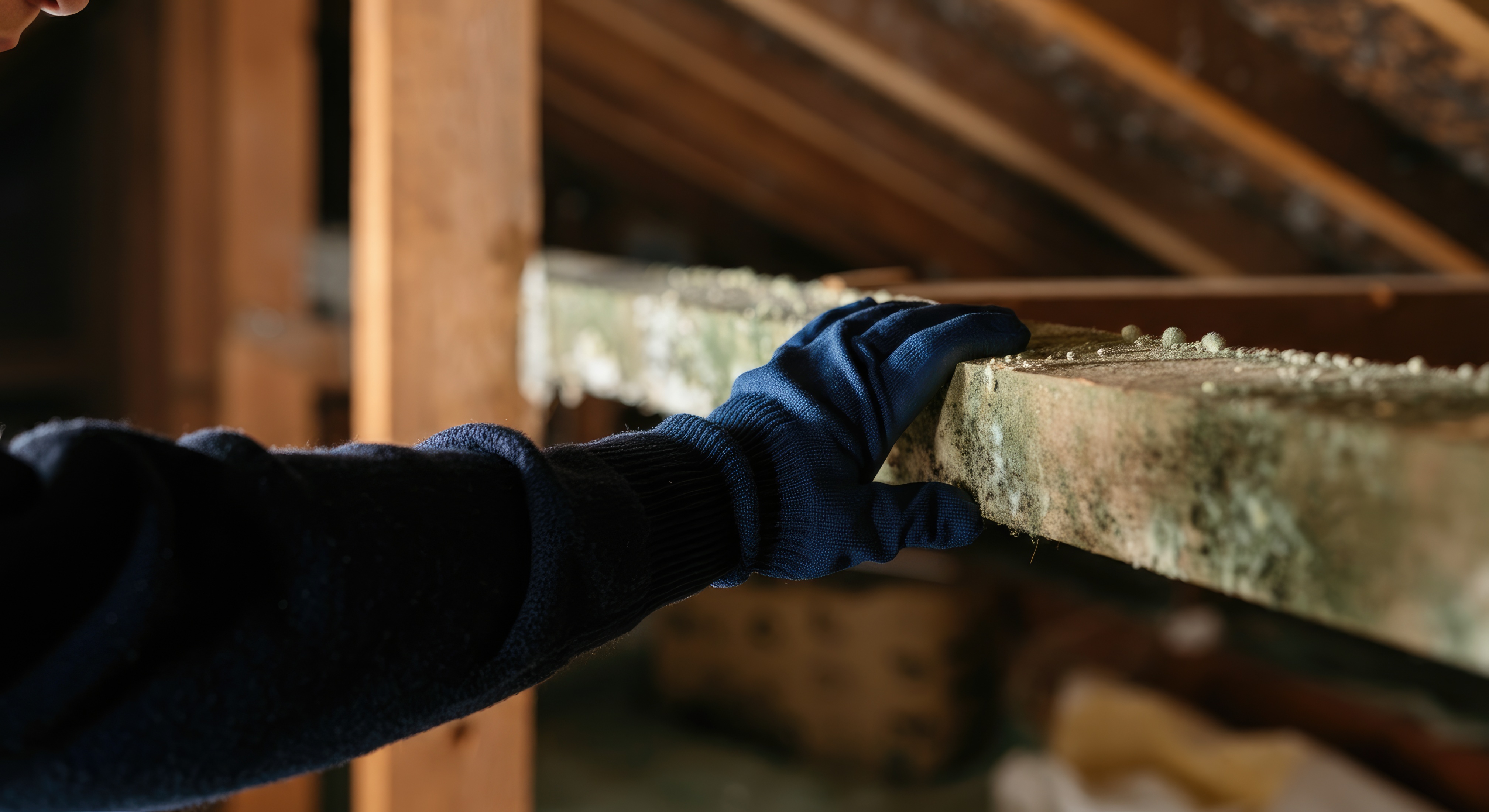
Some of the worst mold problems in a house start in the places nobody feels like checking.
The attic.
The crawl space.
The parts of the home that are easy to ignore until they stop being easy to ignore.
In Cottonwood Heights, that matters more than a lot of homeowners realize. These are the spaces where moisture can hang around quietly, where small issues can get comfortable, and where mold can build momentum long before anything looks obviously wrong in the main living area.
That is the real problem. By the time something in the house starts to smell off, feel off, or show subtle signs of moisture, the source may have already been there for a while.
Most people are not climbing into the attic on a random Tuesday or crawling under the house just to see how things look.
So if there is no dripping water, no ugly stain spreading across the ceiling, and no big obvious warning sign, it is easy to assume everything is fine. That is how these problems get away with staying hidden.
Attic and crawl space mold usually does not make a dramatic entrance. It tends to build from the kind of issues homeowners are tempted to shrug off. A little trapped humidity. A small roof leak. Ventilation that is not doing its job. Moisture that should have dried out, but did not.
Nothing about that sounds dramatic at first. That is exactly why it gets missed.
People tend to think of attics as hot, dry, and harmless.
Sometimes they are. Sometimes they are where moisture gets stuck and quietly overstays its welcome.
Warm air rises. Condensation happens. Ventilation falls short. A roof issue lets in just enough moisture to create a problem without making a scene about it. And because most homeowners are not regularly up there looking around, those early clues can sit unnoticed for a long time.
That is one reason attic mold removal in Cottonwood Heights ends up being more common than people expect. Not because every attic is a disaster, but because attic problems are easy to miss until they have had time to settle in.
Crawl spaces have their own personality, and it is not a helpful one.
They are enclosed, dim, and usually not getting much attention. If moisture starts collecting there, it can linger. If damp air settles in, it tends to stay put. If mold starts growing, it is not exactly doing it in a place where somebody is likely to spot it right away.
And the strange part is that the first sign is often not in the crawl space at all.
It might be:
That is what makes crawl space issues so annoying. The symptoms show up upstairs while the real problem keeps hanging around below.
Usually not the mold itself.
Usually it is the little stuff, the kind of thing that feels easy to explain away once or twice.
Things like:
None of that automatically means mold. But when those signs keep circling back, they deserve more than a shrug.
That is the frustrating part.
Attic and crawl space mold tends to keep doing its thing while the rest of the house goes on looking mostly normal. It does not need much attention to keep spreading. Give it time, give it moisture, give it a part of the house nobody checks often, and it can turn a smaller problem into a much more expensive one.
That can mean damaged insulation, stained wood, lingering odor, and cleanup that gets more involved than it needed to be.
Not because the issue started huge. Just because it had time.
In a lot of homes, the first instinct is to focus on the most obvious rooms first. That makes sense. But hidden mold problems do not always start where daily life happens. Sometimes they start above the ceiling or below the floor, in places that are easy to forget until the signs spread into the rest of the house.
That is why early clues matter. A home that smells musty for no clear reason, feels damp in odd ways, or has recurring signs of moisture is usually telling you something. The sooner that gets taken seriously, the better the odds of catching the problem before it turns into a larger restoration issue.
In Cottonwood Heights, attic and crawl space mold gets missed for the simplest reason possible: those are the parts of the house people think about last.
And unfortunately, that is sometimes exactly where the trouble starts.
If the house smells musty, feels damp in odd ways, or just seems a little off without a clear explanation, it is worth paying attention. A lot of hidden moisture problems do not start in the obvious places. They start overhead, underfoot (or somewhere just out of sight long enough to become a bigger headache than they should have been.)